Ashur University and Its Path Toward the Fourth- and Fifth-Generation University
When discussing Iraqi universities that have begun transitioning from the traditional university model toward the Fourth- and Fifth-Generation University paradigm, Ashur University represents a noteworthy experience that merits particular attention. This is largely due to its implementation of a comprehensive range of academic, scientific, and institutional practices that are aligned with the requirements of this transformation.
Ashur University has adopted the Course-Based System and the Bologna Process, while continuously updating its academic curricula and aligning them with the evolving needs of the labor market. The University has also established advisory boards at the college and departmental levels, bringing together academic and professional expertise. These boards contribute to the continuous development of educational programs in accordance with the requirements of various professional and industrial sectors.
One of Ashur University’s distinctive strengths is the diversity of its academic ecosystem. The University encompasses a broad spectrum of medical, engineering, scientific, and humanities disciplines through its College of Medicine, College of Dentistry, College of Pharmacy, College of Health and Medical Technologies, College of Engineering, College of Engineering Technical Sciences, College of Administration and Economics, and College of Law. In addition, the University offers emerging disciplines in areas such as Artificial Intelligence, Cybersecurity, Robotics, and Digital Technologies.
This academic diversity enables Ashur University to foster a multidisciplinary educational environment, which is regarded as one of the defining characteristics of contemporary universities and an essential foundation for addressing complex challenges that transcend traditional disciplinary boundaries.
At the international level, Ashur University has developed academic partnerships with reputable universities worldwide, including Lincoln University and Teesside University in the United Kingdom. These partnerships have extended beyond ceremonial or protocol-based cooperation to include practical opportunities for student training and skills development. For the second consecutive year, the University has sent groups of students to participate in specialized courses and training programs covering areas such as artificial intelligence, information security, cryptography, sustainability, and other scientific and professional fields.
The University is also building an extensive network of academic and research collaboration with a number of Iraq’s established universities, including the University of Baghdad, Al-Mustansiriyah University, Al-Nahrain University, the University of Technology, the Iraqi University, and the University of Babylon, among others. These efforts are complemented by cooperation with specialized scientific and research centers across Iraq.
In the medical field, Ashur University operates the Ashur Teaching Hospital, an integrated educational and clinical facility that provides an advanced practical environment for students of medicine, dentistry, pharmacy, and health and medical technologies. The hospital contributes significantly to bridging academic education with professional and clinical practice, while strengthening the integration of education, practical training, and healthcare services.
In the engineering and technology domains, the presence of both the College of Engineering and the College of Engineering Technical Sciences, together with academic programs related to artificial intelligence, cybersecurity, robotics, and other emerging technologies, enables the University to develop an educational environment responsive to the demands of digital, industrial, and technological transformation.
The University is also increasingly committed to connecting graduation projects with real-world challenges and the needs of the labor market, industry, and society, rather than treating them merely as conventional academic requirements. Its colleges and departments are continuously developing teaching methodologies that strengthen students’ practical and applied competencies, thereby enabling graduates to make a more effective transition from university life to professional employment.
As part of its commitment to lifelong learning and continuous skills development, the Center for Continuing Education plays an important role in providing professional and training programs that respond to labor-market needs. These include initiatives aimed at strengthening English-language proficiency, while also making use of the University’s international partnerships and academic networks.
The University is further moving toward the development of academic incubators and entrepreneurship centers designed to support innovation and transform students’ ideas and projects into viable and applicable initiatives. This represents a fundamental component of the modern university model, particularly in terms of connecting academic knowledge with the economy, industry, and society.
Why Can Ashur University Be Considered a Model of the Fifth-Generation University?
A Fifth-Generation University should not be defined merely by the presence of artificial intelligence or technology-oriented academic programs. Rather, it should be assessed by its ability to integrate education, scientific research, innovation, entrepreneurship, international partnerships, community engagement, sustainability, and labor-market needs within a coherent and interconnected institutional framework.
From this perspective, what distinguishes the Ashur University experience is its effort to bring these elements together within an integrated ecosystem: curricula aligned with labor-market requirements; the Course-Based System and the Bologna Process; broad academic diversity; international partnerships; international training opportunities for students; emerging technological disciplines; research collaboration; continuing education; applied graduation projects; an integrated teaching hospital; and a strategic move toward academic incubators and entrepreneurship centers.
Accordingly, if the criterion for evaluating a modern university is its ability to provide students with contemporary learning, capacity building, practical and professional skills, international exposure, and meaningful preparation for the labor market and the future, Ashur University offers an advanced and promising model that deserves recognition among Iraqi universities moving toward the Fourth- and Fifth-Generation University paradigm.
This is particularly evident in the University’s diverse portfolio of medical, engineering, technological, administrative, and legal disciplines, together with its ongoing efforts to connect these fields with labor-market demands and global scientific and technological developments.
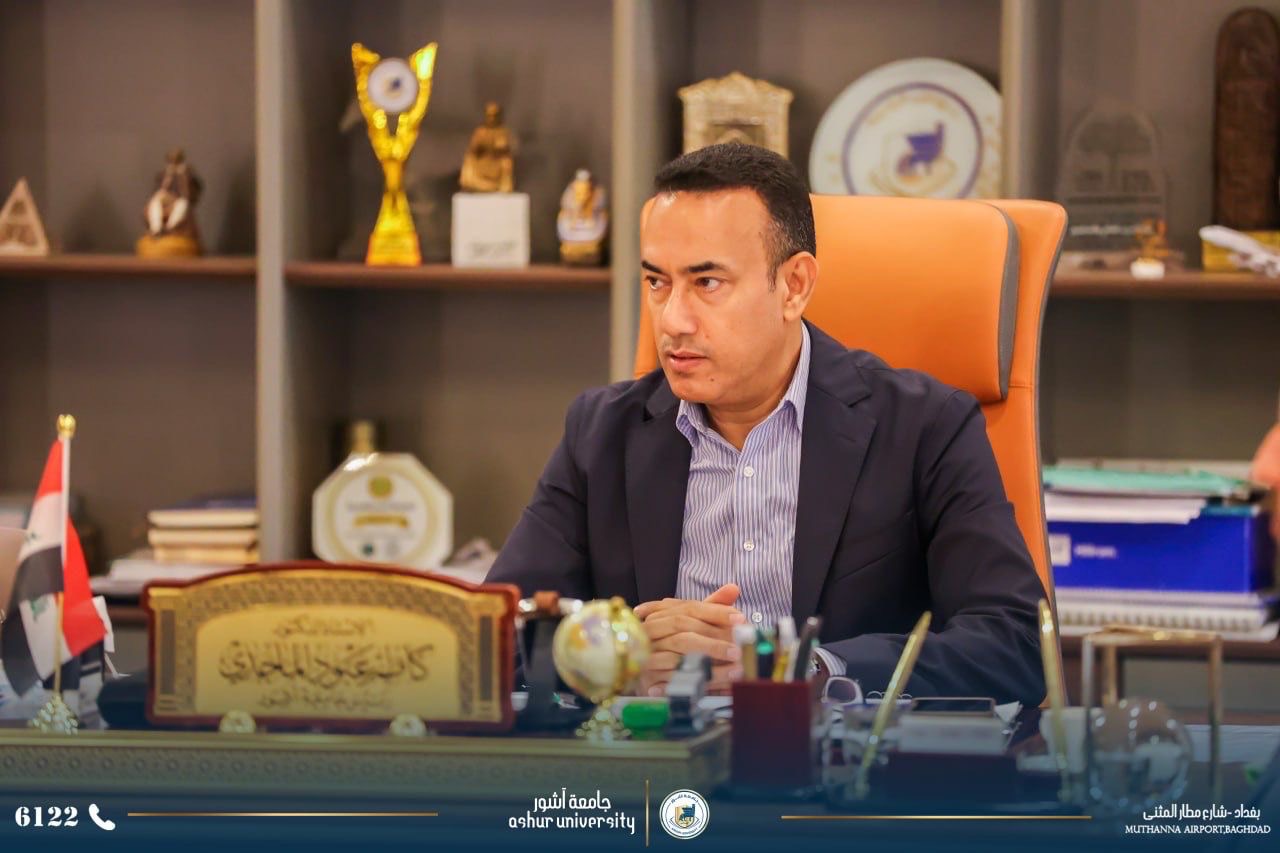
President of Ashur University