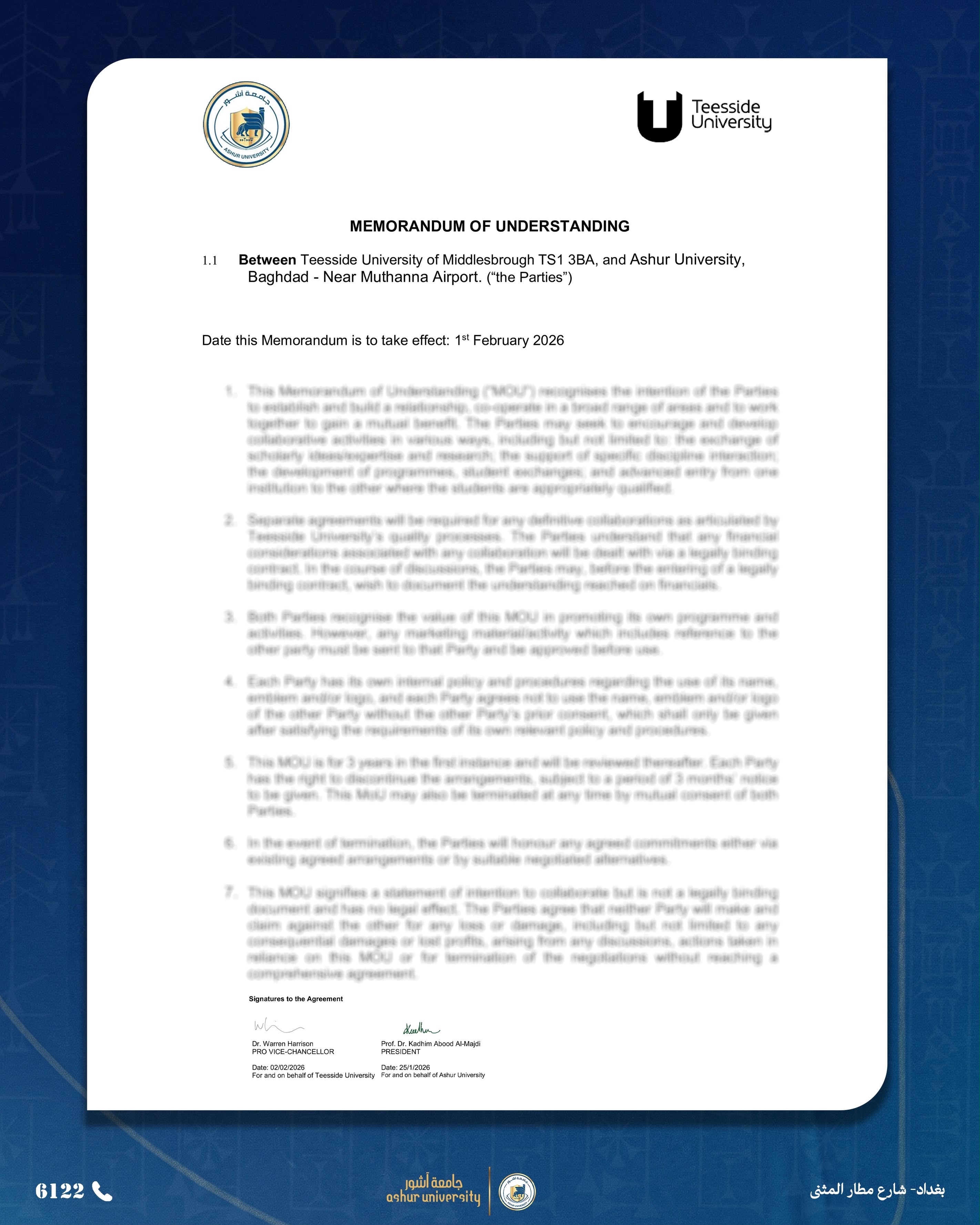
Ashur University signs a memorandum of understanding with Teesside University in the UK to enhance academic and research cooperation.
As part of Ashur University's strategy to expand its international partnerships and strengthen its global academic presence, the university signed a Memorandum of Understanding (MoU) with Teesside University in the United Kingdom, a leading British university in higher education and scientific research.
The MoU, which is valid for three years and is renewable, aims to establish a framework for joint cooperation between the two universities in several academic and scientific fields, contributing to shared interests and enhancing the quality of education and scientific research.
The MoU includes several areas of cooperation, most notably:
• Exchanging academic expertise, scientific ideas, and research findings between faculty members and researchers.
• Enhancing collaboration on joint research projects and activities.
• Developing academic and specialized programs that meet international standards.
• Facilitating student exchange and providing academic and training opportunities.
• Exploring mechanisms for advanced admissions and student transfers between the two universities in accordance with established academic regulations. The memorandum affirmed that any future collaborative programs or projects will be governed by separate executive agreements that define the academic, administrative, and financial aspects in accordance with the regulations and bylaws of both institutions.
The memorandum of understanding was signed by Professor Dr. Kadhim Aboud Al-Majidi, President of Ashur University, and Professor Dr. Warren Harrison, Vice-Chancellor of Teesside University, reflecting both institutions' commitment to developing sustainable academic relationships and building fruitful international partnerships.
This agreement aligns with Ashur University's vision of engaging with prestigious international universities and providing outstanding educational and research opportunities for its students and staff. This will contribute to raising the level of academic performance, enhancing scientific and cultural exchange, and preparing graduates with the necessary skills to compete in the academic environment and the job market at both the regional and international levels.